
A small museum almost hidden at the back of a courtyard, itself tucked away on a discreet yet no less prestigious square in chic Saint-Germain. In this article we share our honest, first-hand opinion of a guided tour, to help you decide whether you'll find there what you love or are looking for!
Let's start with Place de Furstemberg: the most charming square in Paris?
The Musée Delacroix stands on rue de Furstemberg, frequently ranked as the most expensive street in Paris. The narrow streets of Saint-Germain-des-Prés are charming, of course, but they hum with an endless flow of passers-by, summer and winter alike. Even on a sunny day in November, tourists and Parisians alike come here to stroll. To us, the neighbourhood itself is a little overrated. There are streets just as lovely in the 2nd arrondissement: rue Bachaumont and rue Léopold Bellan, for instance, which run off rue Montorgueil, a stone's throw from the Duc de Choiseul Flat. Even more discreet, rue de la Lune, a small sloping street near the church of Notre-Dame-de-Bonne-Nouvelle and the Chess Studio, is in our view every bit as worth the detour.
Rue de Furstemberg is loved for its little old-world square. This is where you will find the entrance to the museum's courtyard; the museum's own façade cannot be seen from the street. A florist adds to the square's charm, but in our eyes its beauty comes above all from the façade of the former abbot's palace on its south side, today a campus of the Institut Catholique de Paris (a private university).
If we had to name the most beautiful (small) square in Paris, our choice would not go to Place de Furstemberg – despite its four paulownia trees, including a very young one replanted in 2023 after an 80-year-old tree that threatened to fall was cut down. The Cité de Trévise would rather get our vote. Its cobblestones, its central fountain and above all the bottle-green railings around its garden, the same wrought iron you find around some metro entrances, make it, to our mind, even more quintessentially Parisian. It is also closely lined with very elegant dressed-stone buildings with finely carved pediments, whereas those on rue de Furstemberg strike us as rather ordinary. Take a look at the door of number 6, Cité de Trévise! To stay a few minutes' walk from the Cité de Trévise, the Duc de Choiseul Flat (for 4) and the Chess Studio (for 2) are ideal.
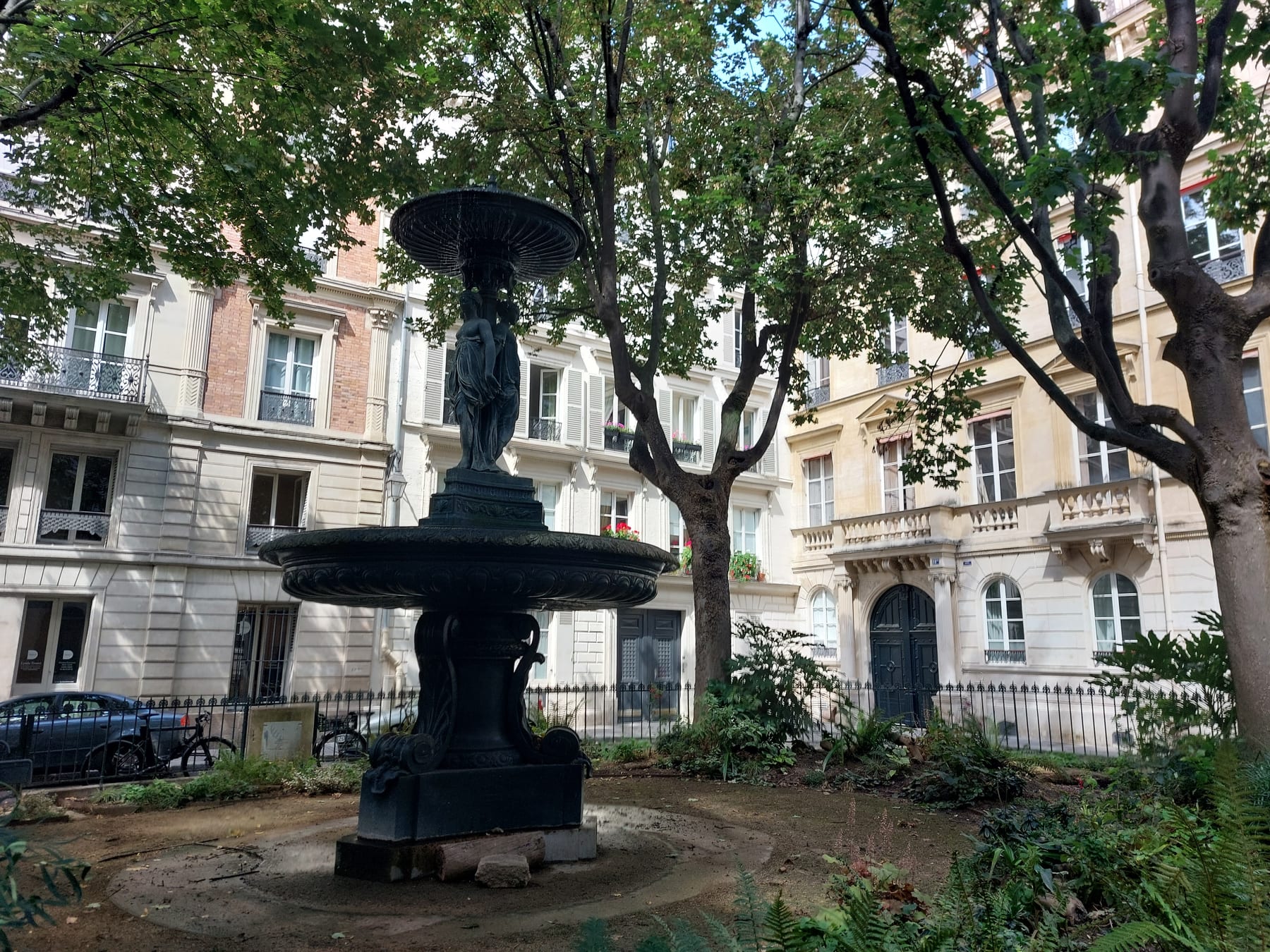
Back to Place de Furstemberg. A short break on its central island is still well worth it, but don't be late for the guided tour.
The apartment, studio and garden of an "Illustrious" figure
First opened to the public in 1932, the museum was originally a private apartment, sharing a garden with the rest of the building. Delacroix rented it from December 1857 until his death in 1863, so as to live a stone's throw from the church of Saint-Sulpice, which had entrusted him with a major commission: the paintings of the Chapel of the Holy Angels. He negotiated private use of the garden with the landlord in order to build his studio there, with a large west-facing bay window and a glass roof to let in as much light as possible and work late. He decorated the west façade with small sculpted muses. The volume of this studio gave him the space he needed for his monumental works.
The peaceful garden, where you can see the bell tower of Saint-Germain-des-Prés delicately reflected in the studio window, has not always been so tidy: Delacroix preferred it wilder, full of flowerbeds, plants and flowers.
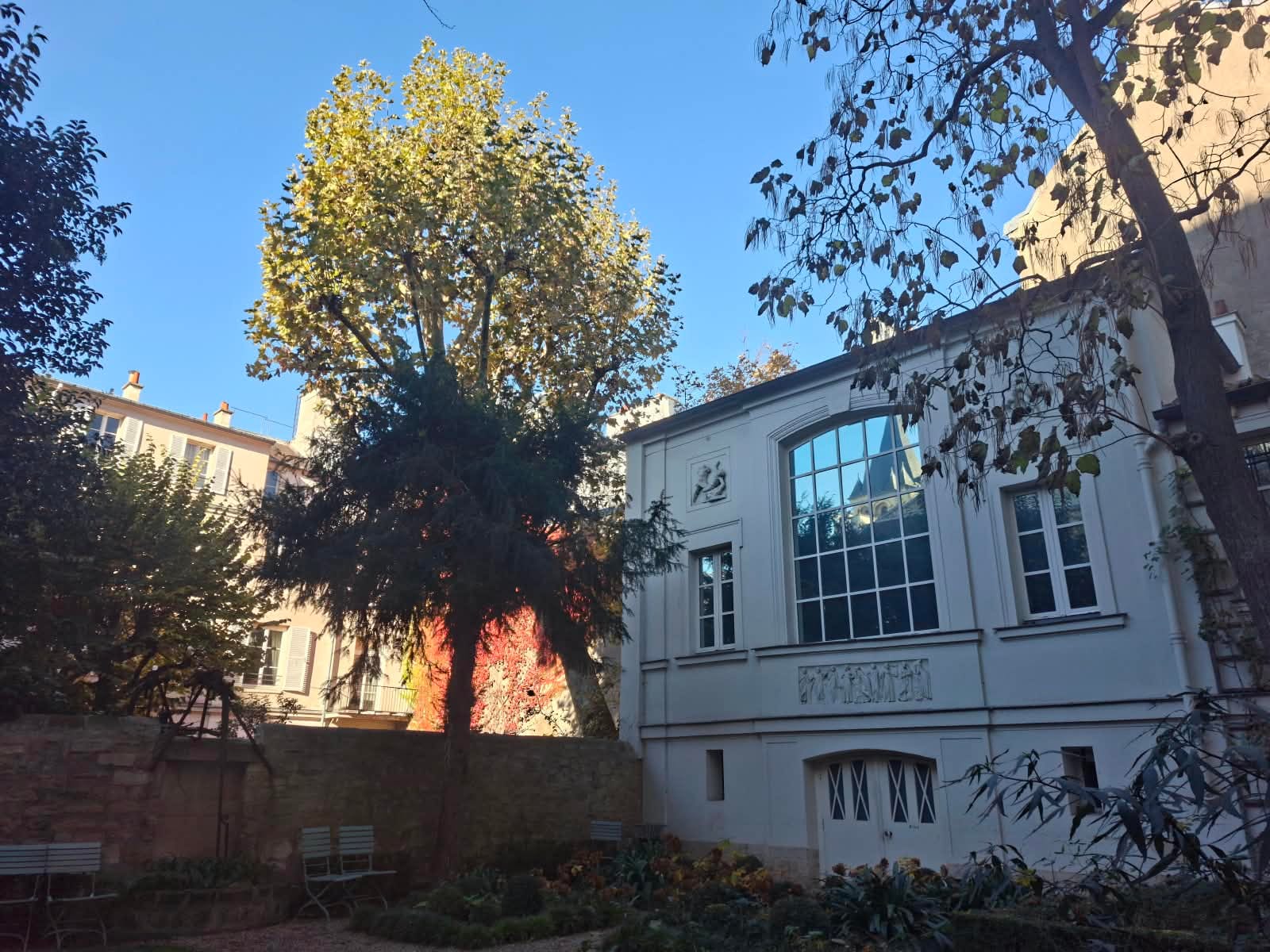
After his death the place remained in private hands, and the studio was for a time threatened with demolition.
Led by the Société des Amis d'Eugène Delacroix, founded in 1929 around Maurice Denis and Paul Signac, a first exhibition was held there to trace the history of the many works the painter had left behind, which the association had preserved. It donated the whole to the French State in 1954. The museum is now part of the Louvre. It belongs to the Maisons des Illustres ("Houses of Illustrious People"), a label of the French Ministry of Culture for places of memory linked to famous figures, alongside Victor Hugo's house on Place des Vosges or the discreet Musée Gustave Moreau.
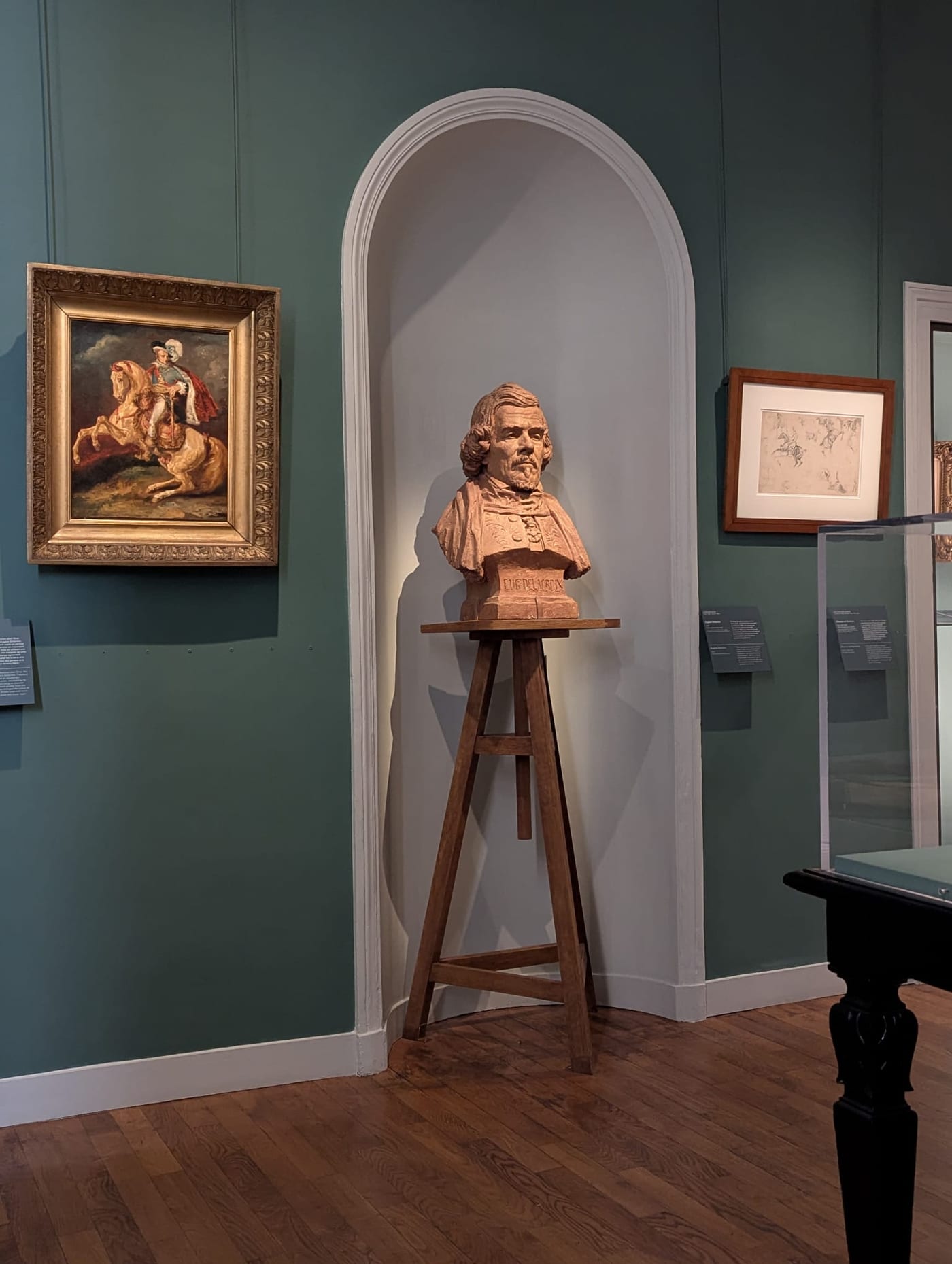
A guided tour full of anecdotes
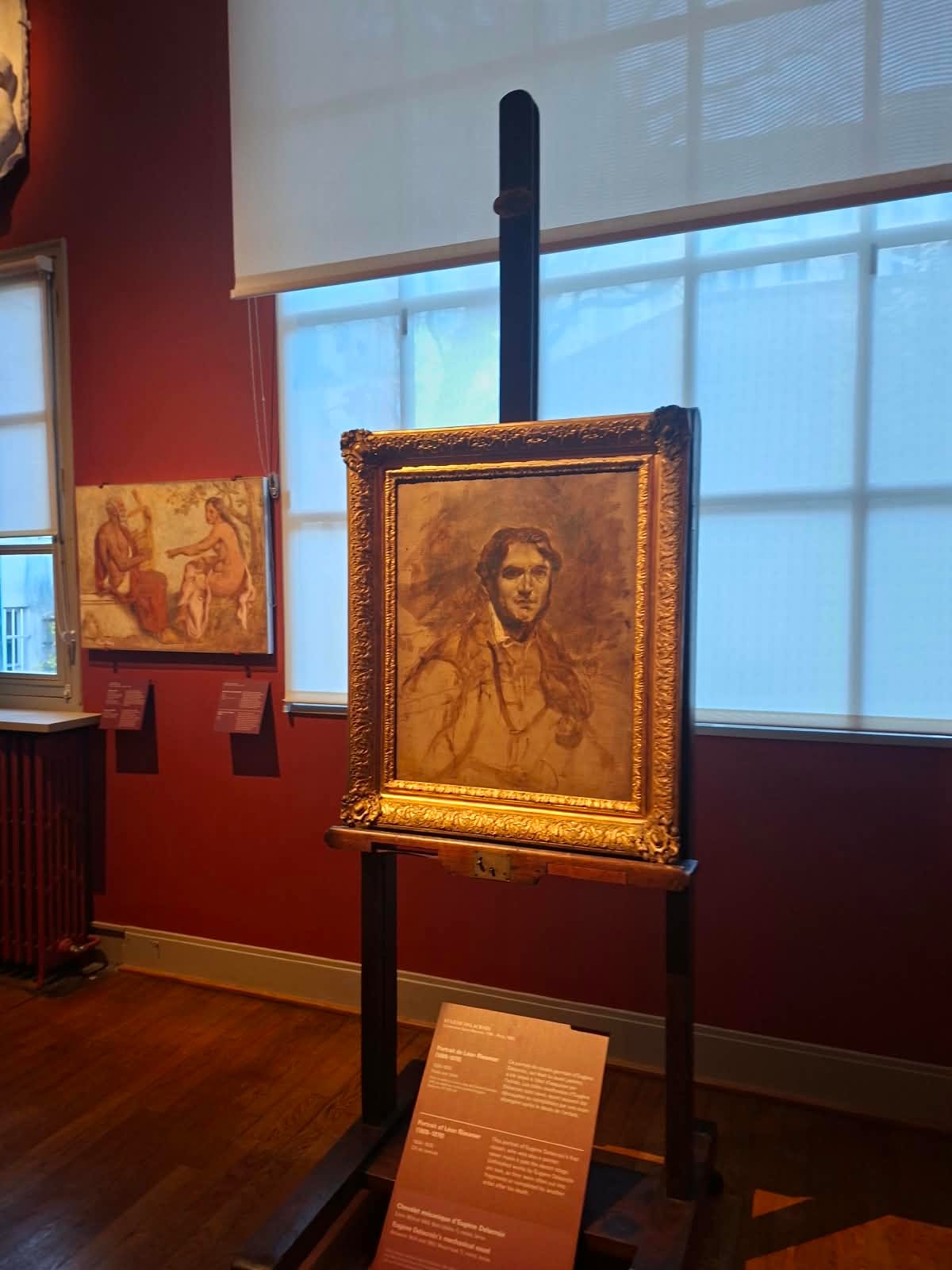
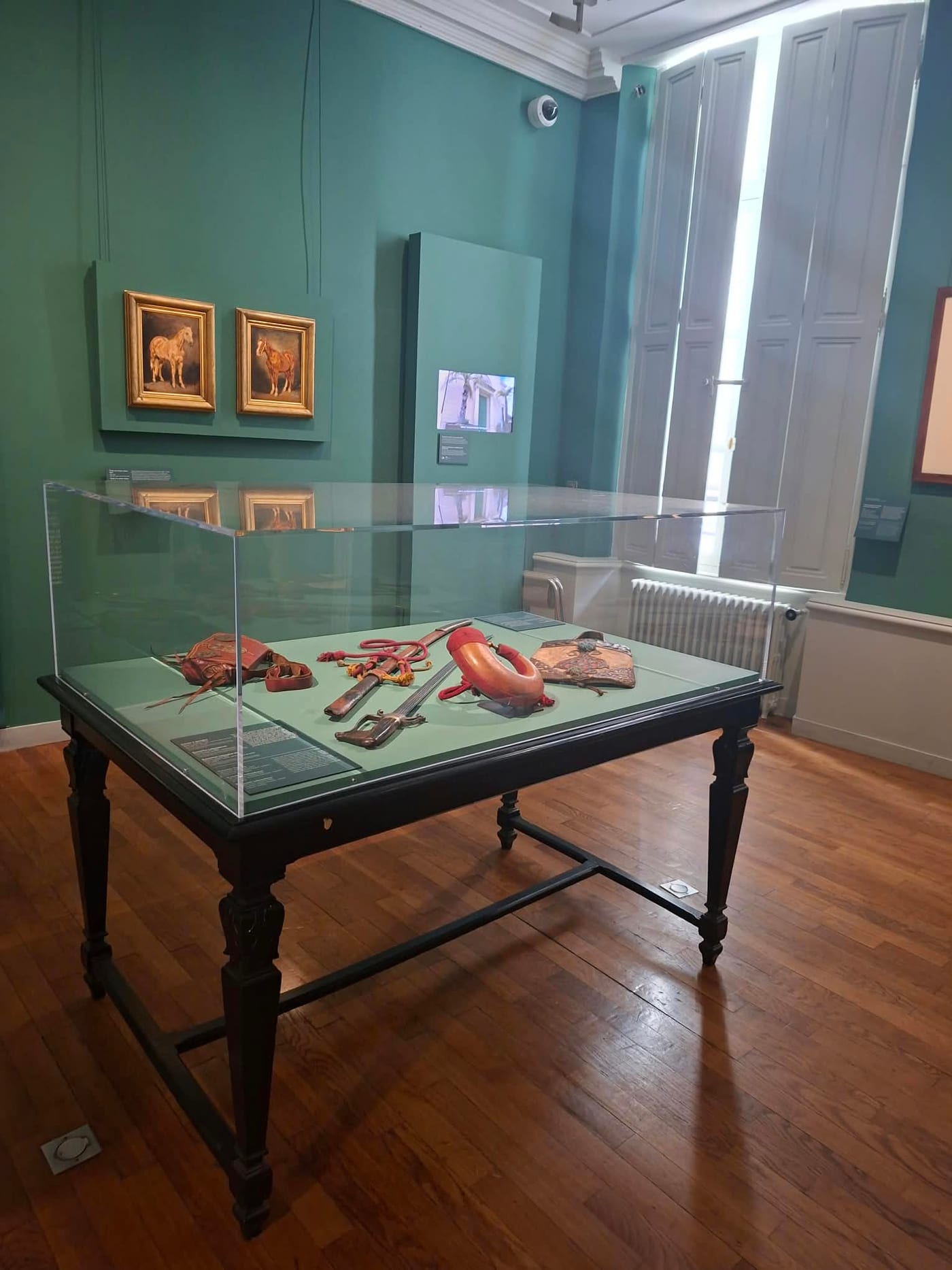
The guided tour covers what drove Delacroix throughout his life, but it can go beyond Delacroix himself depending on your questions. The guide talks about how the painter's way of working was reconstructed from the studio collection found at his death: drawings, sketches, extremely rare unfinished paintings, objects brought back from his travels such as armour and horse harnesses… But much more besides: his ties with other artists, politicians and the events of his time… And also some particularities of the Louvre, just a 20-minute walk from the Duc de Choiseul Flat.
You learn, for instance, that the cards of authorised copyists at the Louvre, kept over a very long period, are a great help to art historians and curators. And that when a large-format work, like the Delacroix paintings held at the Louvre (rather than at the small Musée Delacroix), has to leave the Louvre to be exhibited elsewhere in the world but won't fit through the doors… a window gets sawn open! Rolling up a 19th-century canvas would risk damaging it.
Delacroix, an ambitious man
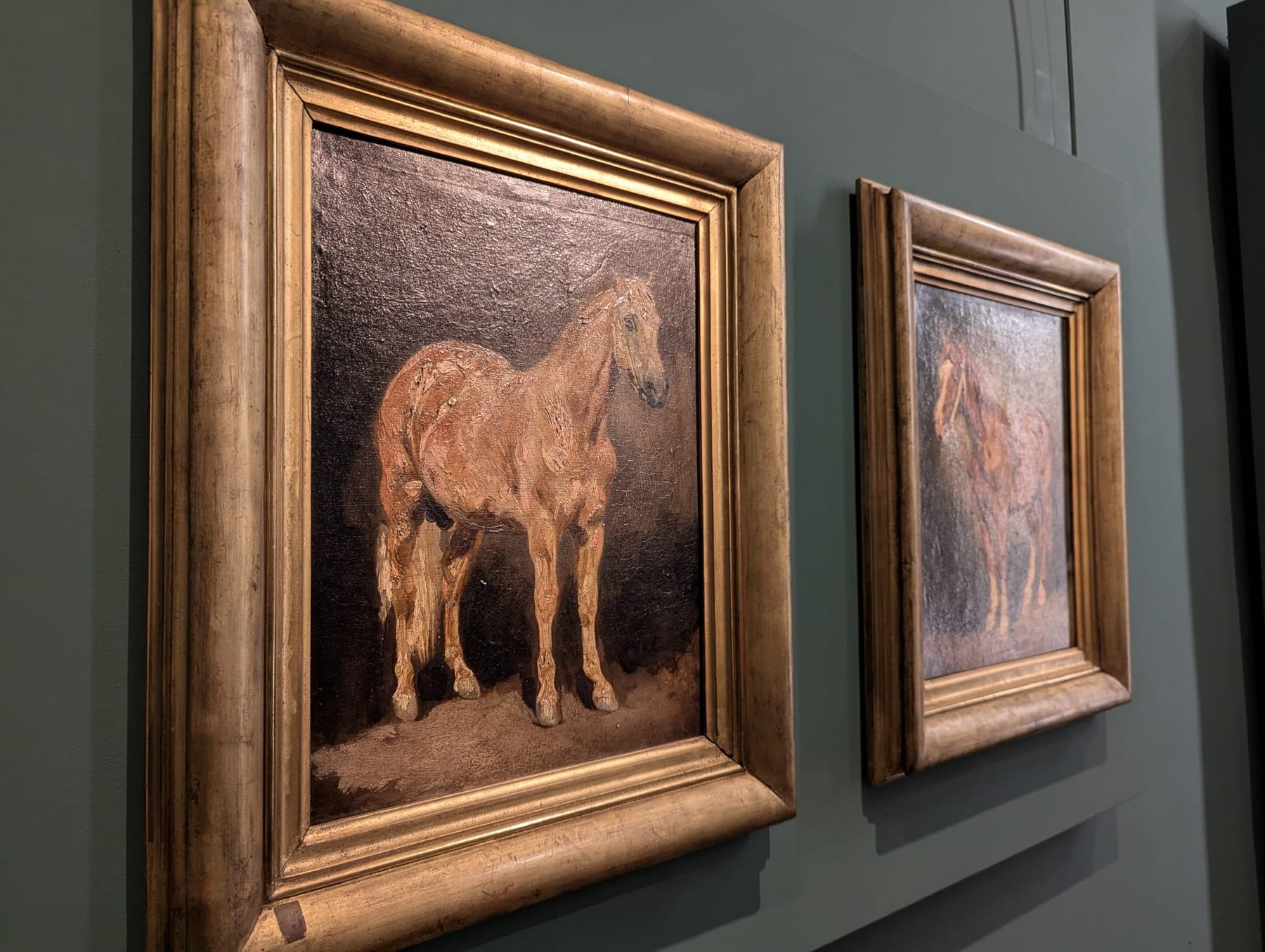
Talented from an early age, Delacroix practised on studies of men and animals, especially chestnut horses, which would serve him all his life. For him the male nude was not a subject in itself: he studied it to understand anatomy, then placed the figure back into a far grander painting.
He made no secret of seeking glory. To that end he cleverly chose subjects that appealed to the public as much as to governments, and sold to the State very early in his career. He did not necessarily take risks. Everyone supported Greek independence: he painted The Massacre at Chios in 1824. He also painted scenes that could be called "commercial", such as Romeo and Juliet at the Tomb of the Capulets. In a stark contrast of black and white, beside the dark silhouette of a monk, Romeo finds the lifeless body of Juliet, whom he believes dead. He will take his own life, and Juliet, on waking, will kill herself in turn on seeing him dead.
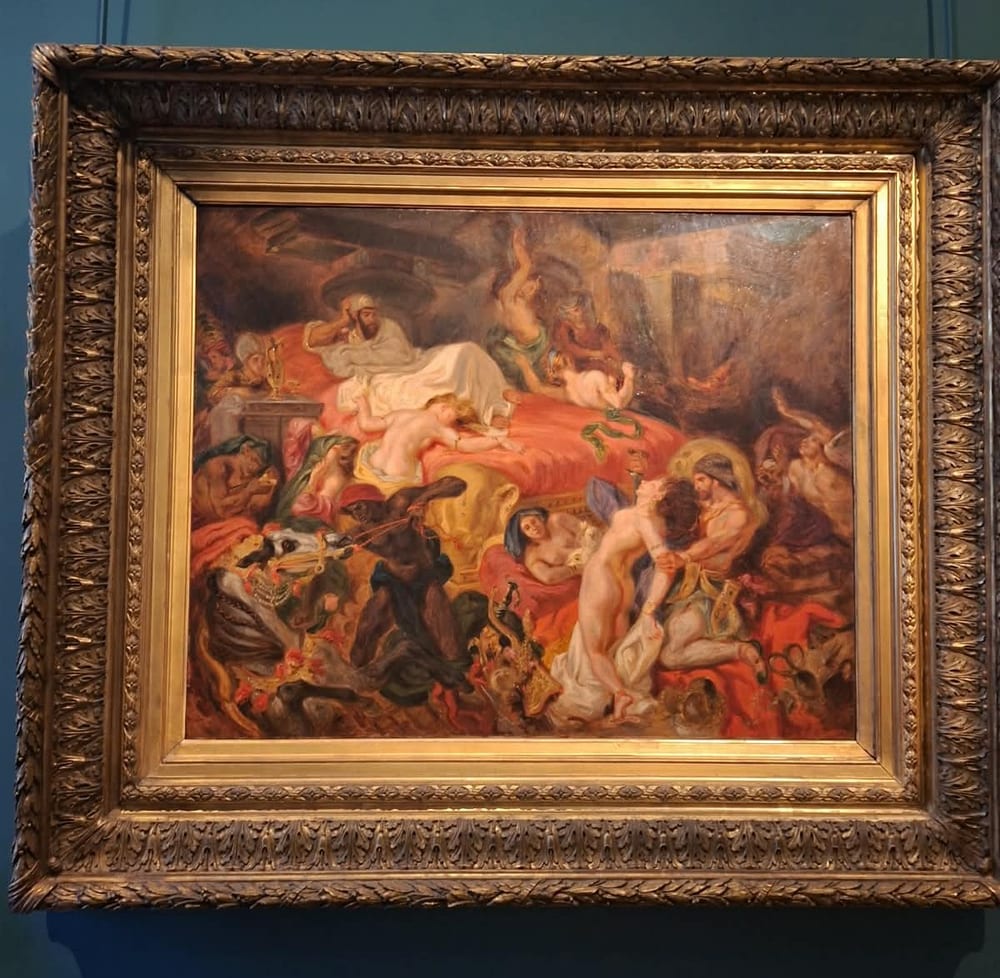
There are exceptions, though. The Death of Sardanapalus (1827), in which the despot, knowing his city lost, has his concubines and horses killed before dying on his pyre, met with a mixed reception… In fact, it caused a scandal.
Liberty Leading the People, bought by the State in 1831, was almost immediately put into storage as too subversive. It was eventually returned to Delacroix, for whom a work was meant to be seen, but he would never see it enter the Louvre (1874). That said, the ultimate honour: the Uffizi in Florence asked him for his self-portrait for its Gallery of Self-Portraits (1840s).
Late in life, feeling his career was established, he took more freedom with his subjects, even allowing himself to paint the plants of his garden on rue de Furstemberg.
A Romantic? Not so simple
Delacroix produced many large, very academic history paintings, which brought him the fame he was after. But he also painted events of his own time, which had happened only months or years before. Fully a man of his age, he spent time with Théodore Géricault and the animal sculptor Antoine-Louis Barye. Like the rest of Paris, he went to see Zarafa the giraffe ("the elegant one") at the Jardin des Plantes, an extraordinary story: she is now preserved at the natural history museum in La Rochelle. More decisively, shocked to see French people killing each other during the 1830 revolution, he painted Liberty Leading the People.
Delacroix is classed as part of the Romantic movement, led by Géricault, and more precisely among the painters for whom colour prevails over line. But it takes the strength of both to build a reputation that has crossed two centuries to reach us, as shown by his portrait on the 100-franc notes of 1979. In fact, the Romantic label does not suit him very well. Some paintings do convey the power of a nature greater than man, even savagery, like his horse battles. But some elements get in the way of a strict classification.
Delacroix was a complete painter with a wide range of themes. Besides the great events of his day, he painted his travels in Morocco and Algeria; religion, handled with subtlety (he erased the Virgin's halo in The Education of the Virgin); and scenes drawn from novels, plays and poems, such as the lithograph The Combat of the Giaour and the Pasha, inspired by Byron: Delacroix was an avowed Anglophile who travelled to England several times. He also occasionally paid tribute to the old masters (a painting of a blacksmith in the tradition of the Le Nain brothers).
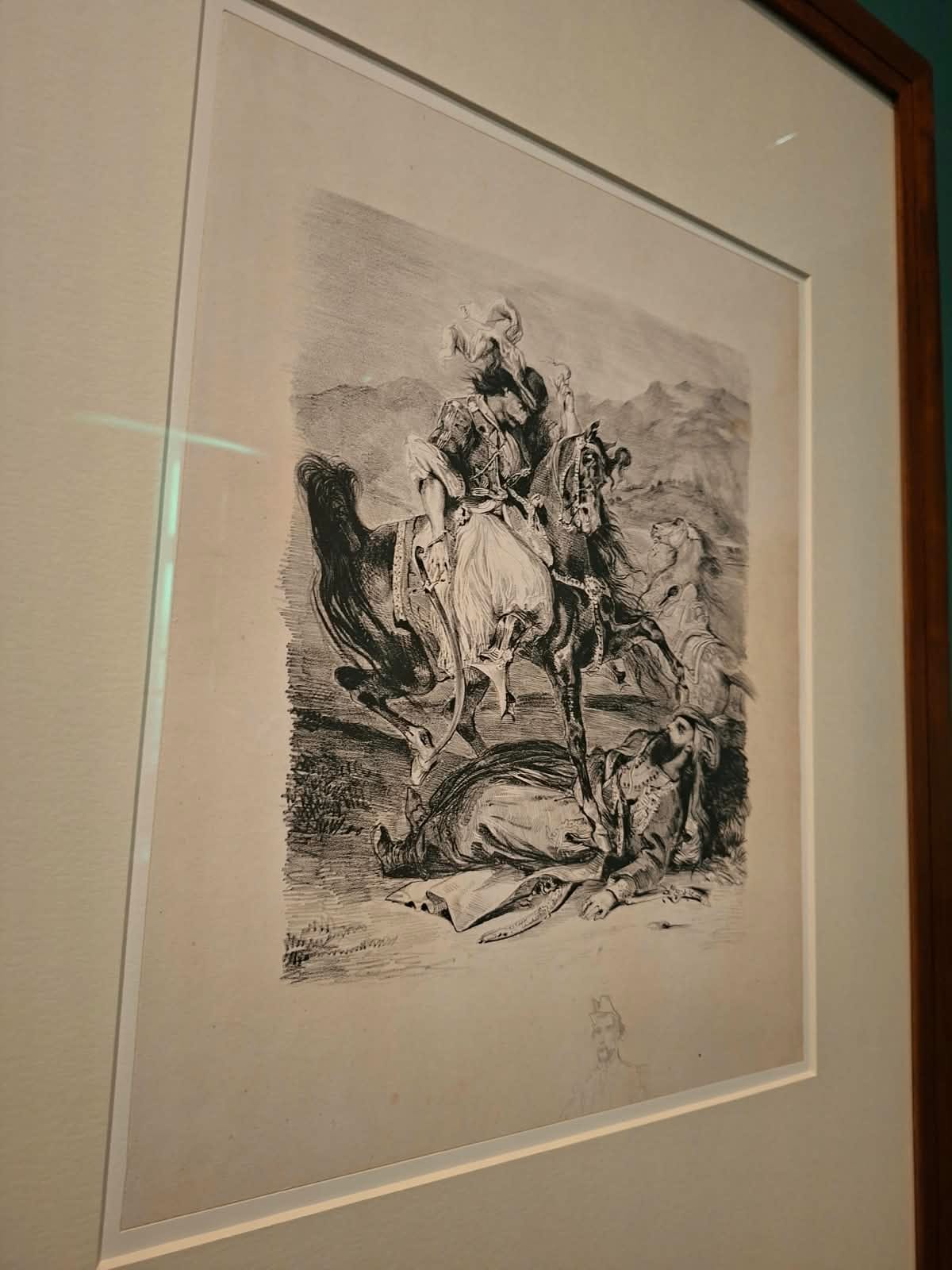
A fun detail: at the bottom of one engraving, you can spot a tiny sketch of a figure that has nothing to do with the subject. Delacroix must have urgently needed paper! Paper was scarce at the time, every bit of space was worth using, and the same went for canvases.
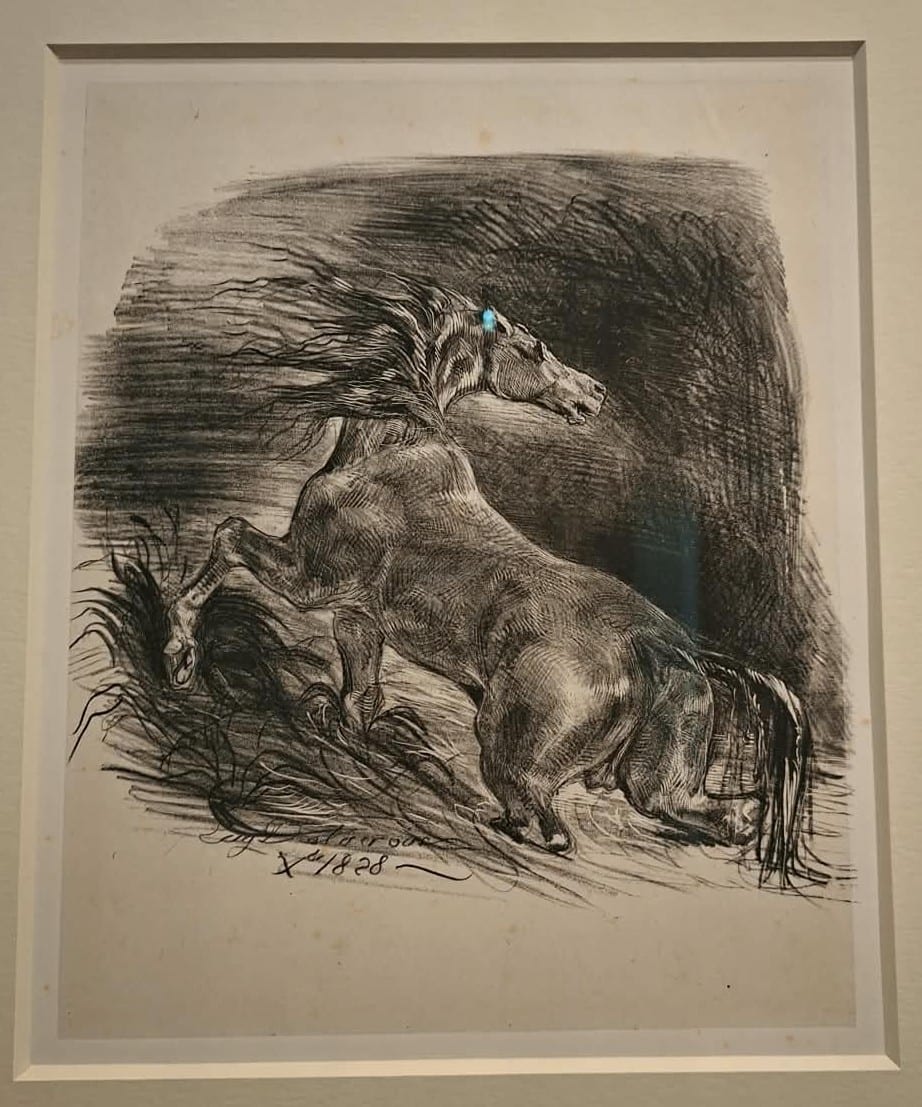
Without seeing himself as an animal painter, Delacroix studied horses in the streets of Paris with Géricault, and big cats at the Jardin des Plantes with Barye. Horses, tigers and lions are everywhere in his work: admired for their power, they were also excellent subjects for trying to depict movement in painting. For a long time, galloping horses were painted with all four legs stretched out, off the ground. It took until 1878 and the photographer Eadweard Muybridge to break down reality: a dozen cameras lined up along a track, triggered one by one by wires as the horse passed. Although it turned out that a horse's legs fold under its belly when it is off the ground, many painters went on showing horses "flying", to heighten the sense of speed.
Less attached than Géricault to anatomical accuracy, more anthropomorphic, Delacroix played with distortion: a horse's neck exaggeratedly long and twisted to convey panic. All with a touch of his own: quick in some places, with deliberate impasto in others to catch the light.
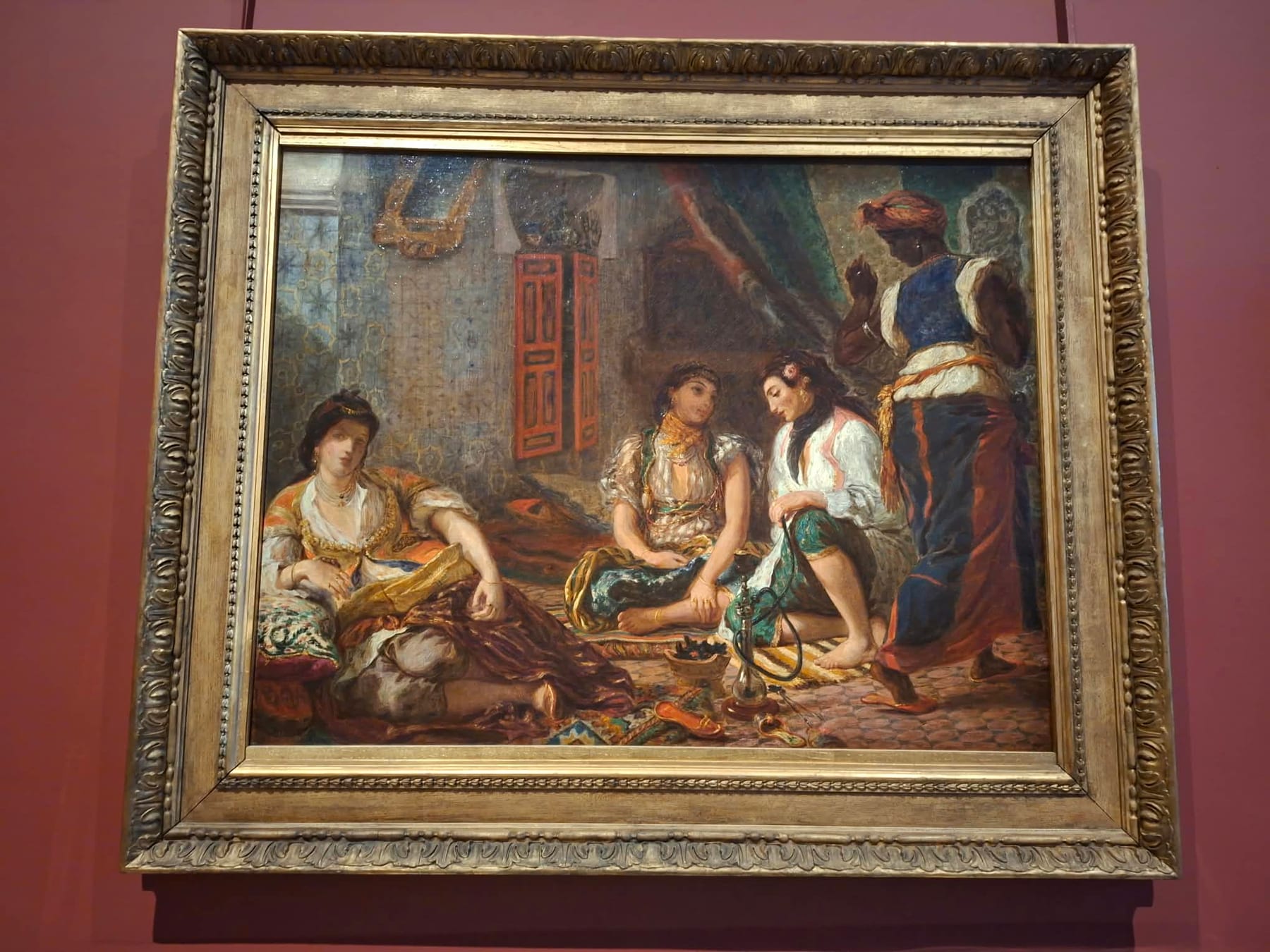
Orientalism was a recurring theme for the Romantics. Delacroix painted many pictures that could be linked to it, drawing on Napoleon's Egyptian campaigns and on the work of Gros for some engravings. But his point of view was entirely different. In The Women of Algiers, a copy of which by Fantin-Latour hangs in the museum, one detail should catch the viewer's eye. The Orientalists glorified an Orient that fascinated them and gave free rein to their imagination. Delacroix painted what he actually saw on his trip to North Africa in 1832: women who were dressed (not permanently naked in harems, as people liked to imagine), one of whom, in the centre of the painting, even wears a pocket watch, a detail far too modern to please lovers of the genre.
The great decorative schemes, his real tour de force
In our view, it is in his large decorative schemes that Delacroix's virtuosity shows best. The models on display help you understand his paintings for ceilings, domes and half-domes (known in French as culs-de-four, literally "oven bottoms"). He won the most prestigious commissions: the Salon du Roi and the library of the Assemblée Nationale (1833-1848), the dome of the Senate library (1840-1846), the ceiling of the Galerie d'Apollon at the Louvre (1850), and the Chapel of the Holy Angels at Saint-Sulpice (1861). Seeing his work installed in the Louvre in his lifetime was an extremely rare honour, which he shared with Ingres, his great rival.
The technical challenge is impressive. Delacroix did try fresco, for an abbey, but it did not suit him. You cannot sketch the scene out beforehand, as he liked to do, and it does not forgive mistakes: any correction means scraping it off and starting again. So he painted in oil on canvas that was then glued in place (marouflée), rather than directly onto the vault. He had to work out how to bring the right image, in the right light, to the eye of a viewer standing beneath the dome, not lying down. And he worked with strips of canvas of varying sizes, which the maroufleur then had to fit together perfectly. As with any great show, the difficulty is invisible.
What to take away from a visit to the Musée Delacroix?
Beyond the must-see works you can admire at the Louvre, the Musée Delacroix sheds a complementary light. The studio collection gathered by the Société des Amis de Delacroix helps you understand his original sources of inspiration. The preparatory work, shown in all its roughness, helps you understand the whole technical construction of a painting.
In contrast to its extremely prestigious neighbourhood, we appreciate the modesty of the works on display and their limited number. This studio collection might seem disjointed to anyone without the keys to read it, but it comes together fully during the guided tour, and in the way the museum's team arranges it.
Unfinished canvases, pencil sketches, black-and-white engravings, perhaps less eye-catching than the great paintings in vivid colours, small-format copies (by artists no less eminent, such as Fantin-Latour) take you off the beaten track.
Practical information
To make the most of the moment, walk up rue de Seine or rue Mazarine towards the river (Quai de Conti). Then take the Pont des Arts to reach the Louvre, or the Pont-Neuf, which makes for a pleasant detour across the Île de la Cité.
- Address: 6 rue de Furstenberg, Paris 6th. Metro Saint-Germain-des-Prés (line 4) or Mabillon (line 10).
- Time needed: about 1 hour without a guided tour (it's a small museum), 1 hour 30 with the one-hour guided tour and a little wander on your own at the end.
- Price: €9. Free for under-18s, and for under-26s resident in the European Union.
- Tip: your Louvre ticket gives you access to the Musée Delacroix on the same day or the next.
- Closed on Tuesdays. Check opening hours and book the guided tour on the museum's official website.