
Built as a Greco-Roman ‘monument theatre’ on the eve of the Revolution and tossed by the storms of History, the Odéon-Théâtre de l'Europe is commonly described as the oldest theatre in Paris. Strolling across the sought-after Place de l'Odéon, in the chic 6th arrondissement where the price per square metre is among the highest in Paris, it is hard to imagine that the Odéon was once a recurring hotbed of protest. A tour, floor by floor, of a house where the curtain never quite comes down.
A Temple Raised for the King's Players
In the late 18th century, Antiquity shaped the architectural arts: in keeping with the elites' taste for the simplicity and rational beauty of Greek and Roman temples, buildings adopted columns, pediments and symmetry. It was in this neoclassical spirit, after the classicism of the Grand Siècle, that Charles de Wailly conceived the Odéon as a temple devoted to theatre. The name "Odéon" comes from the Greek odeion, the place where one declaims, where the city gathers to listen and debate. One must picture the atmosphere of the late 18th century: the theatre was a place of social display before it was a place of artistic performance.
The Théâtre de l'Odéon was born of a grievance from the King's Players who, unlike the troupes of foreign courts, had no theatre of their own: they were forever moving their sets and costumes. Weary of this, they complained to the brother of Louis XVI, who seized on the Crown's purchase of the Prince de Condé's estate to install a theatre for them, inaugurated in 1782 by Marie-Antoinette. In 1784, Beaumarchais's The Marriage of Figaro met with wild success there: Marie-Antoinette adored it, seemingly without grasping the critique of the social order carried by this impertinent comedy — a critique that would help kindle the French Revolution.
The Revolution split the troupe in two. On one side, the king's supporters; on the other, the children of the Republic, led by the great Talma, who took half the company off to the hall that would become the Comédie-Française. Those who remained at the Odéon, loyal to the Ancien Régime, would be imprisoned or guillotined. The Odéon took on the colours of revolutionary vocabulary, obsessed with the idea of the Republic, renaming itself Théâtre de la Nation, then Théâtre de l'Égalité.
Later sold to unscrupulous investors, the theatre curiously burned down — the insurance cashed in, only the façade remained. It was rebuilt identically under Napoleon, where Joséphine insisted that only comedies be staged there, never dramas. The Odéon would change its name again with each regime — Théâtre de l'Impératrice, Odéon-salle Luxembourg, Théâtre de France in 1959 — before becoming the Odéon-Théâtre de l'Europe we know today.
A Recurring Hotbed of Social and Political Protest
The Odéon has always beaten to the rhythm of the political tensions of the eras it has lived through:
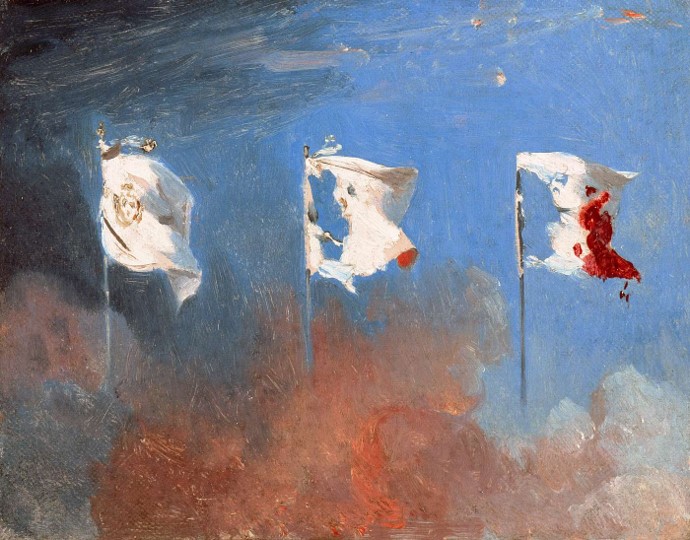
- In 1830, during the Trois Glorieuses, the streets around the theatre were among the first to see barricades rise, and the theatre became the rallying point of a revolutionary youth thirsting for freedom of expression. The Trois Glorieuses led to the overthrow of Charles X and, in turn, the end of the senior branch of the Bourbons.
- A leap forward in time: in 1966, Jean Genet's The Screens, an openly anti-militarist and anti-colonial play, sparked a riot inside the auditorium — smoke bombs, objects hurled onto the stage, a fire set in the third balcony by enraged spectators.
- In May 1968, a revolutionary action committee occupied the Odéon for nearly three months, in defiance of the bastions of bourgeois culture. A permanent performance without a director began, with thousands of occupiers flying red and black flags. The director Jean-Louis Barrault, a towering figure of the theatre, refused to drive them out — which would cost him his post.
- Closer to our own time, in the spring of 2016, the Nuit Debout movement took the floor there in turn, amid a labour-law reform seen as undermining workers' rights.
Malraux and André Masson's Sky
In the 1960s, André Malraux, Minister of Culture, set out to restore the lustre of France's great venues. He chose André Masson to give the Odéon a resolutely modern ceiling: The Coronation of Apollo, a vast composition that seeks to depict the very emotions one feels before a work of art.
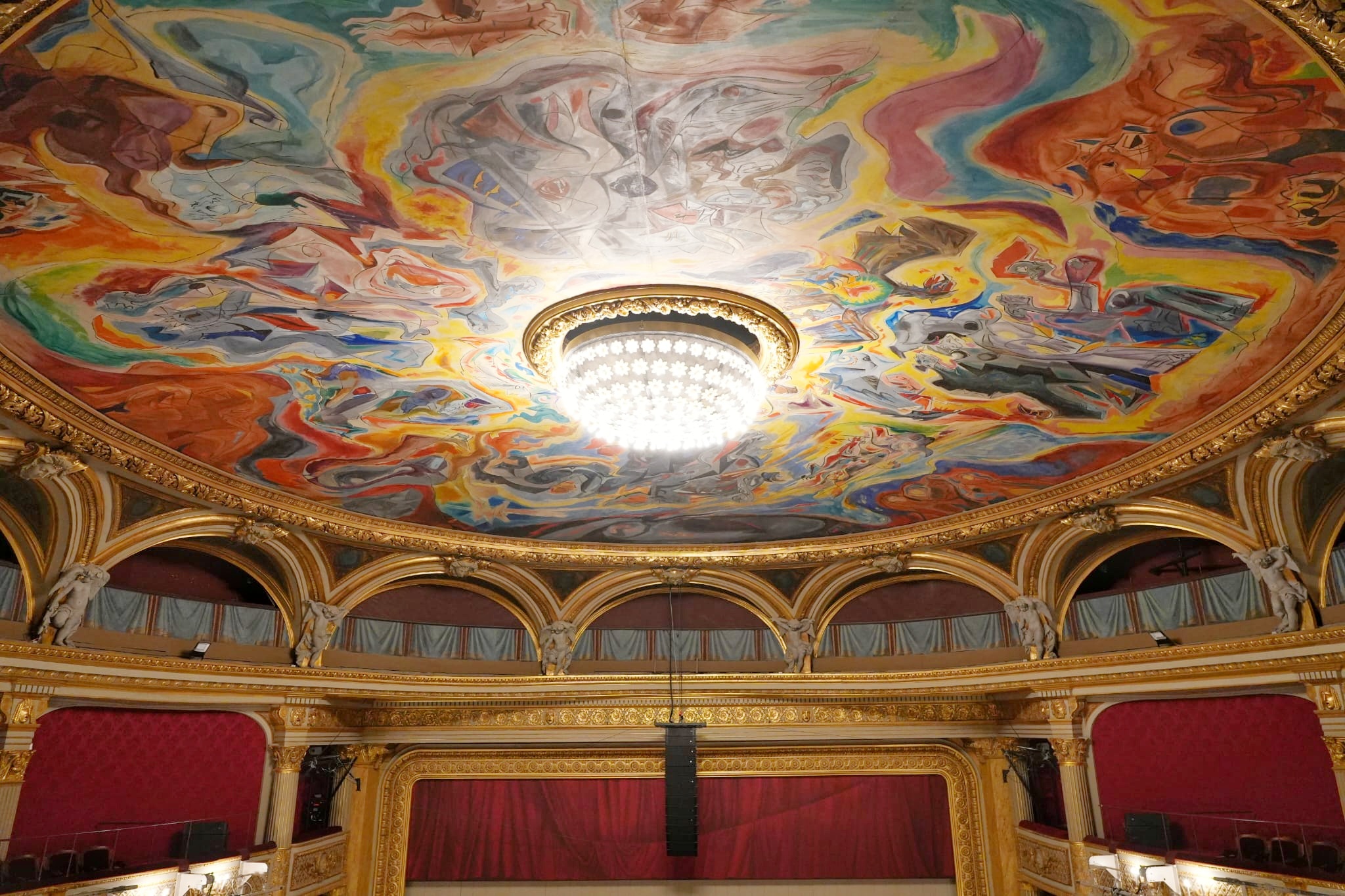
In the early 2000s, the Odéon underwent four years of renovation that required the theatre to be dismantled from floor to ceiling — Masson's canvas itself was taken down. It reopened in 2006.
The Auditorium, Floor by Floor
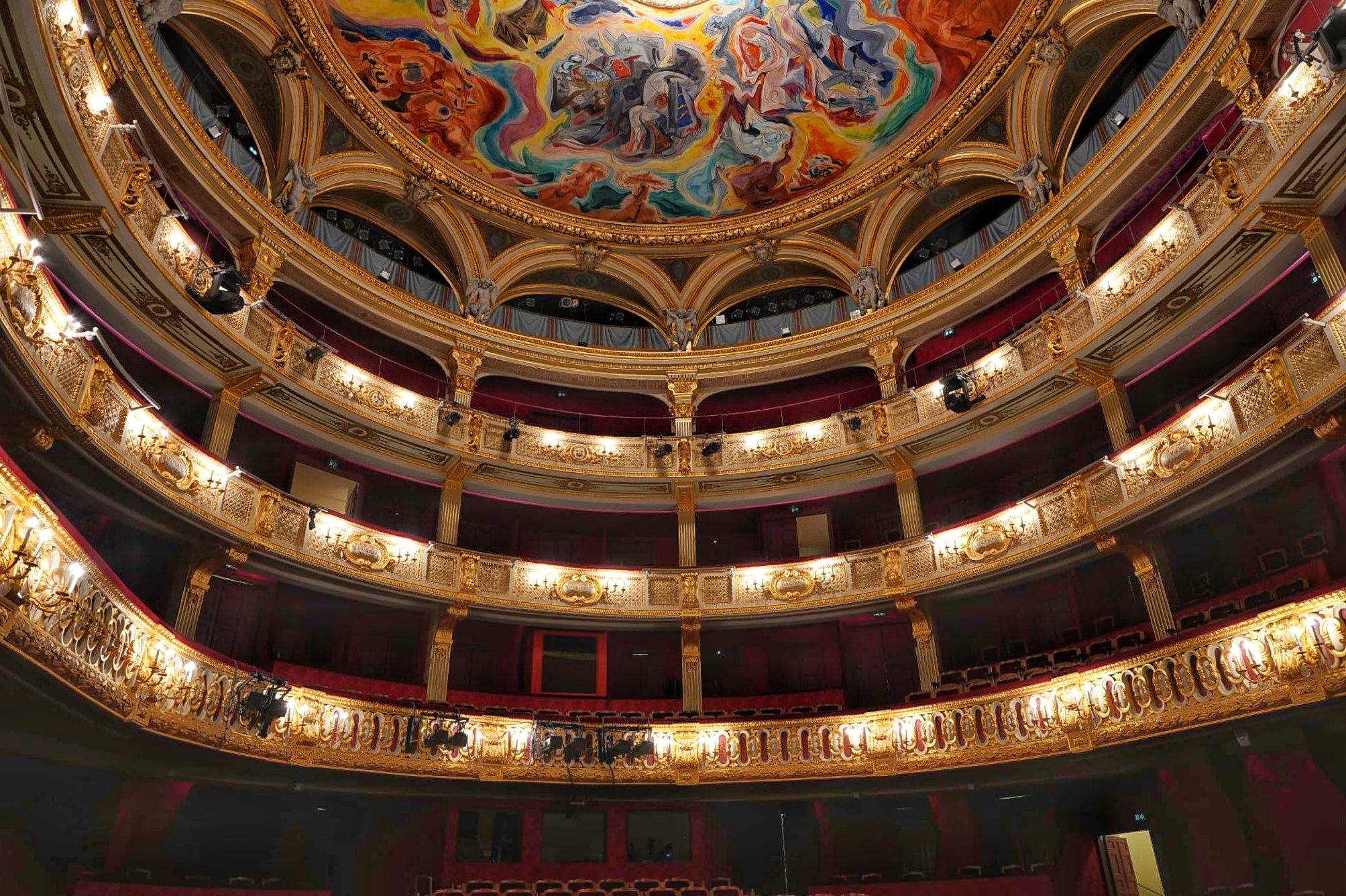
The Odéon is an "Italian-style" auditorium, curved to carry the voice. Seating was minutely codified.
Why was the parterre at the very bottom (today's orchestra) the cheapest, the very opposite of today? The parterre was, in fact, the least comfortable. One stood there, or sat on benches — the Odéon was the first theatre to introduce them. Yet the benches did not make the parterre a choice spot: wax from the candles dripped onto spectators' heads! Hence, so they say, the French expression « cela en vaut la chandelle » (literally "it's worth the candle"). Because of the benches, but also the early use of gas lighting, seats at the Odéon were at the time more expensive than elsewhere.
The bathtub boxes ("loges-baignoires"), enclosed and rented by the year, sheltered the discreet rendez-vous of the nobility. The king had two boxes at the far ends, close to the stage — Louis XVI on the left as you face the stage; the queen sat on the courtyard side (côté cour), on the side of the players' beating hearts. (The balconies have since changed names: the former first balcony is today's corbeille.)
At the very top reigned the "paradise", or "gods" ("poulailler"), where common folk shouted, jeered and threw a thousand things onto the rows below — sometimes right into the ladies' décolletés. French has kept from this the expression « il y a du monde au balcon » (literally "there's a crowd on the balcony", said of a big breast).
Three Knocks and a Box of Smelling Salts: Two Theatre Customs Explained
The famous three knocks that open a performance are struck with a staff called the brigadier: a flurry of quick knocks, then three distinct ones. Where do they come from? Some saw in them a medieval practice to ward off the devil; others, three bows — one to the right toward the king, one to the left toward the queen, one in the centre for the audience. Others still, a signal between stagehands and the stage manager to indicate that everything was ready for the play to begin.
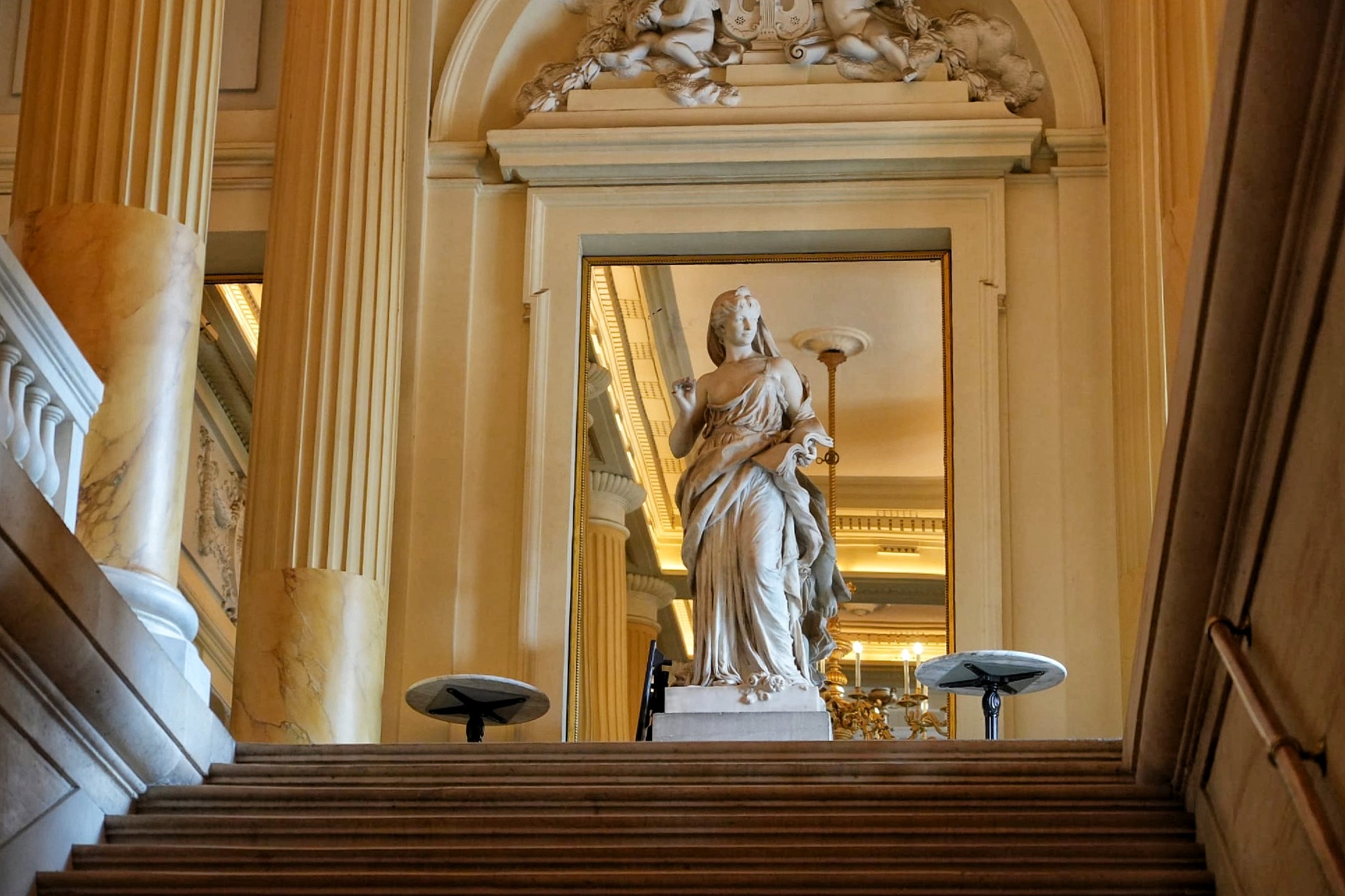
The entrance of the Théâtre de l'Odéon, deliberately narrow so as to usher spectators quickly into the auditorium, is adorned with two statues representing Tragedy and Comedy. A box of smelling salts was kept there: when a lady fainted, she was revived with a whiff of salts. While the ladies preferred to attribute their swoons to emotion, the better to show off their sensibility, one may suppose that the crush of a thousand overheated spectators and the implacable grip of corsets had a great deal to do with it.
Take a Break & Stay Nearby
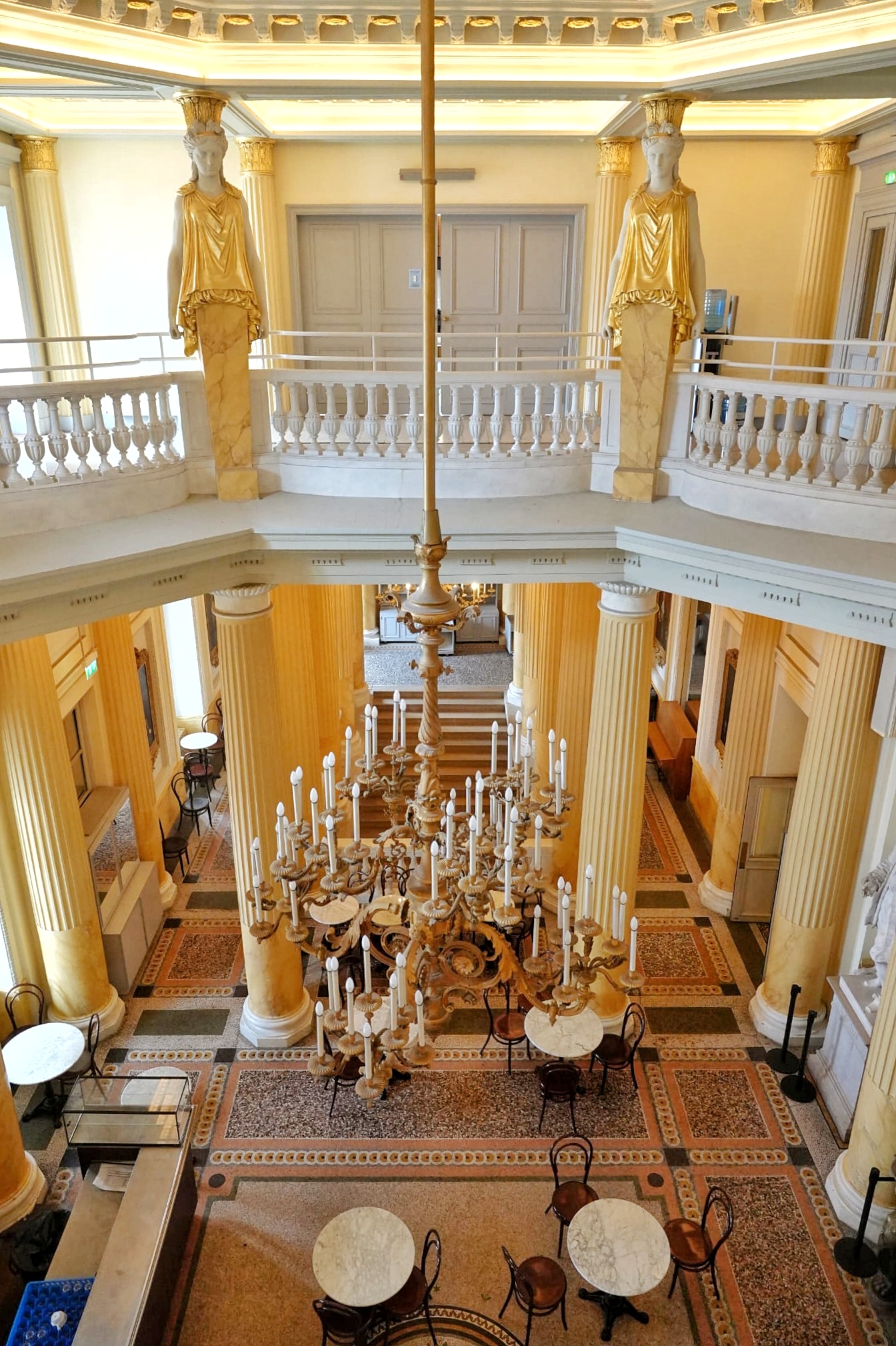
Before or after the show, the Café de l'Odéon opens, from April onwards, a pleasant terrace in the calm of Place de l'Odéon — to which, to our taste, a touch more greenery would do no harm. It serves from noon to midnight (the terrace does close, however, in bad weather).
The Odéon stands at the doorstep of none of our flats, but all of them reach it in a quick journey:
| From | Shortest route | Duration |
|---|---|---|
| Appartement du Duc de Choiseul Opéra – Paris 2 |
  Richelieu-Drouot → Strasbourg-Saint-Denis, then  → Odéon → Odéonor  Bus 39 direct Bus 39 direct |
~25 min |
| Chess Studio Grands Boulevards – Paris 10 |
from Strasbourg-Saint-Denis → direct to Odéon |
~20 min |
| Le Petit Toit Madeleine Concorde – Paris 8 |
 from Madeleine → Châtelet, then → Odéon from Madeleine → Châtelet, then → Odéon |
~20 min |
If you are looking for a place to stay to enjoy the theatre and bring culture to the whole family, choosing the Appartement du Duc de Choiseul, the Chess Studio or Le Petit Toit Madeleine will be ideal: their immediate proximity to numerous metro and bus lines lets you reach absolutely anywhere in Paris very quickly.